Flying Mobile
In today’s fast-paced world, mobile phones have become more than just a need — they’re an inseparable part of our lives.
But one problem still troubles almost every user: weak network signals.
Sometimes calls drop, sometimes the internet stops working.
But this issue may soon disappear, as scientists are developing a new technology that allows your phone to work without network towers or SIM cards!
Welcome to the era of “Air Communication Technology” — where your phone will connect directly through the air.
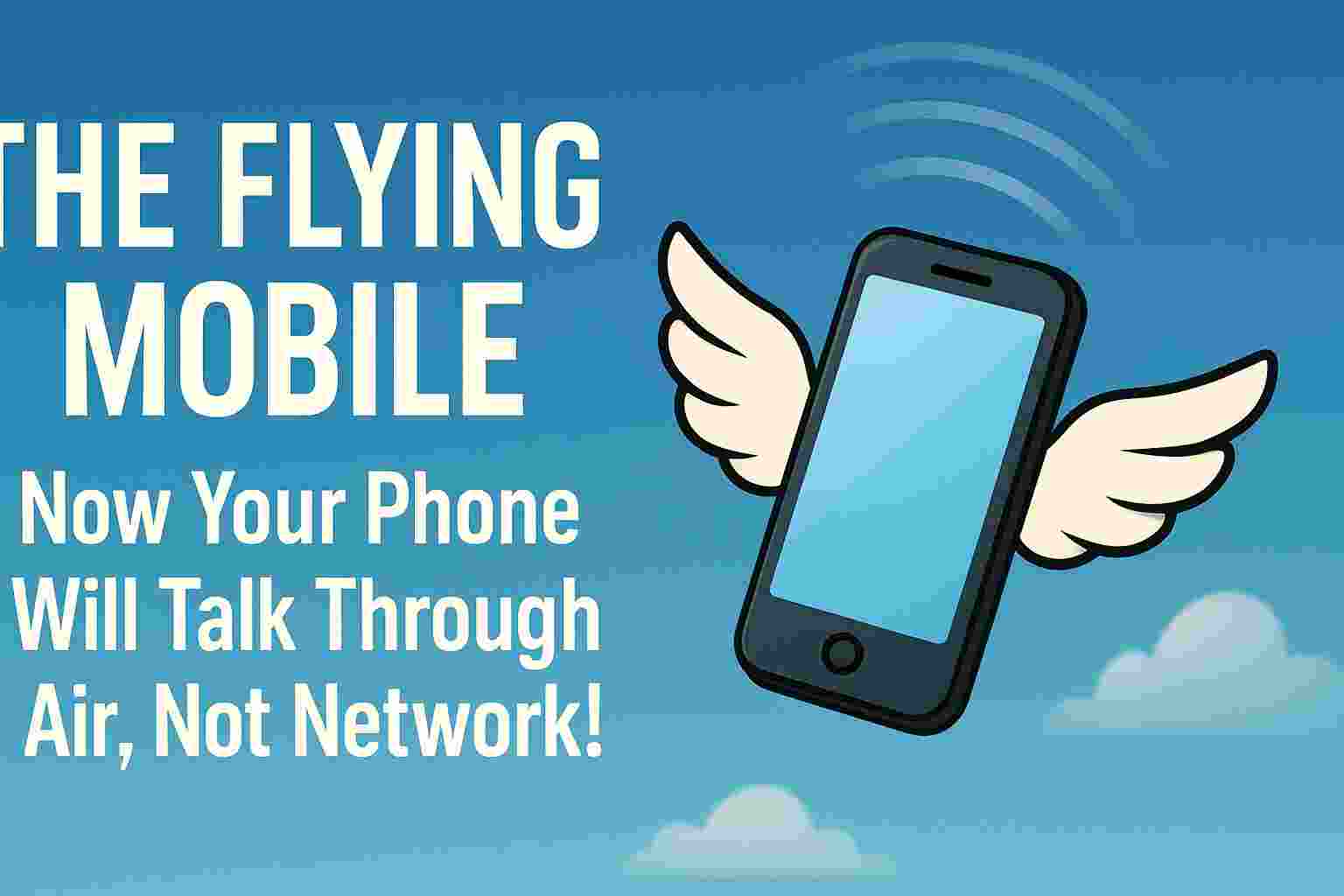
Flying Mobile
📡 The Limitations of Traditional Networks
Currently, every mobile phone depends on cellular towers or satellite networks for communication.
Every call, message, and data packet travels through these towers to reach its destination.
However, in hilly, remote, or rural areas, where towers are absent, network coverage becomes weak or nonexistent.
To overcome this limitation, scientists have introduced a groundbreaking concept —
👉 Air Communication Technology,
where the network is transmitted directly through the air, without relying on any physical infrastructure.
🌐 What Is Air Communication Technology?
Air Communication Technology is an advanced wireless communication system where mobile phones exchange data using radio frequencies (RF) and laser-wave signals.
In this system, instead of depending on cell towers, AI-powered drones and micro-satellites create a floating Air Network Zone above the Earth.
Technically, this setup is known as a “Self-Sustaining Air Network System”,
meaning it can send and receive signals independently — without human intervention.
⚙️ How Does This Technology Work?
The Air Communication System works on three main levels:
🔸 1. Air Drones
Tiny drones equipped with AI systems hover in the sky and transmit network signals from one point to another.
Whenever a region experiences weak signals, these drones automatically move toward that area to strengthen the connectivity.
🔸 2. Laser Communication
Instead of traditional radio waves, this system uses laser beams to transmit data.
Laser communication is much faster and more stable, ensuring almost zero latency during transmission.
🔸 3. AI Signal Mapping
Artificial Intelligence (AI) constantly monitors the strength of the network and automatically adjusts drone positions or satellite alignment based on real-time demand.
This ensures that the network never goes down — no matter where you are.
☀️ Powered by Air and Sunlight
One of the most exciting features of this technology is that it operates on solar and wind energy.
Drones and satellites generate their own power through renewable sources, making the entire network system eco-friendly and energy-efficient.
This reduces both cost and environmental impact.
📱 The Future Smartphone: Air Phone
The next generation of smartphones built for this technology will be known as “Air Phones.”
Instead of a physical SIM card, they’ll feature a built-in Air Module Chip that connects directly to the air-based network.
No more SIM swaps or network dropouts —
just pure, uninterrupted communication powered by the atmosphere itself.
🌎 Global Research and Development
Several countries are already experimenting with this technology:
In the U.S., SkyCell Network has successfully tested drones that can stay airborne for 20 hours while providing seamless coverage.
In Japan, SoftTech Labs is working on an “AirWave Link” project expected to launch by 2026.
In India, researchers from IIT Delhi and ISRO have begun the “AirNet India Mission” to deliver network access to remote rural areas without traditional towers.
💡 How Will This Change Our Lives?
- Global Connectivity – No matter where you are — mountains, forests, or deserts — you’ll always have a stable network.
- Emergency Support – In disasters like floods or earthquakes, when towers collapse, air networks will keep communication alive.
- Cheaper and Faster Internet – With reduced tower costs, internet services will become more affordable and stable.
- Environment-Friendly Solution – No more heavy towers or power-hungry systems; this approach saves energy and reduces pollution.
⚠️ Challenges and Future Scope
Like every revolutionary innovation, Air Communication Technology also faces a few challenges:
Maintaining consistent signal stability
Ensuring data privacy and cybersecurity
Overcoming weather-related disruptions
However, experts predict that by 2030, this system will be fully functional in many regions across the globe.
🌤️ Conclusion: The Air Is the New Network
The concept of a “Flying Mobile” is no longer just imagination — it’s the beginning of a new communication era.
This technology will not only eliminate network barriers but also redefine how humans connect and share data.
A future is coming where every breath carries data, and every breeze brings connectivity.
The network of tomorrow isn’t on the ground — it’s in the air. 🌬️📱