
Meta Description:
Discover how Artificial Rain (Cloud Seeding) works, its real-world applications, benefits, limitations, and how AI and drones are transforming modern weather modification — explained in a clear, factual, and SEO-friendly way.
🌤️ Introduction
As climate change continues to affect rainfall patterns, scientists have developed a method to artificially induce rain from the sky. Known as Artificial Rain or Cloud Seeding, this scientific process is helping regions across the world reduce drought, improve agriculture, and manage water scarcity.
This article explains how Artificial Rain works, where it’s being used, its pros and cons, and what the future of this technology looks like — all in a simple, factual, and professional manner.
☁️ What Is Artificial Rain?
Artificial Rain is a weather modification technique that helps trigger rainfall by dispersing specific substances into the clouds.
These substances encourage condensation — the process by which water vapor turns into liquid droplets — leading to rainfall.
This technique does not create clouds from nothing; instead, it enhances existing clouds that already have enough moisture.
⚙️ How Does Artificial Rain (Cloud Seeding) Work?
Artificial Rain involves three main steps: identifying suitable clouds, injecting specific chemicals, and initiating the condensation process.
- Identifying Suitable Clouds
Meteorologists first monitor cloud formations using radar and satellite data. Only those clouds with sufficient humidity and temperature conditions are selected.
- Chemical Injection
Using aircraft, drones, or ground-based generators, scientists release tiny particles into the clouds. These particles act as “nuclei” around which water vapor condenses.
Commonly used substances include:
Silver Iodide (AgI)
Sodium Chloride (Common Salt)
Potassium Iodide (KI)
Dry Ice (Solid Carbon Dioxide)
- Rain Formation
When water droplets become heavy enough, they fall to the ground as rain.
This entire process is carefully monitored to avoid over-seeding or unintended weather effects.
🌎 Countries Using Artificial Rain Technology
Many countries have successfully implemented Cloud Seeding projects to address local water and agricultural challenges.
China
China operates one of the world’s largest weather modification programs. During the 2008 Beijing Olympics, authorities used Cloud Seeding to manage rain and improve air quality.
United Arab Emirates (UAE)
The UAE frequently uses drone-based cloud seeding to increase rainfall in arid desert regions. The country continues to invest in advanced weather research through the UAE Research Program for Rain Enhancement Science.
United States
Several U.S. states, including Texas, Colorado, and Nevada, conduct Cloud Seeding to enhance water reservoirs and support agriculture during dry seasons.
India
In India, states such as Maharashtra, Karnataka, and Tamil Nadu have carried out experimental Artificial Rain projects to mitigate drought conditions. Research institutions like the Indian Institute of Tropical Meteorology (IITM) are studying its long-term effectiveness.
💧 Benefits of Artificial Rain
Artificial Rain can be an effective solution in regions facing unpredictable rainfall or prolonged dry spells.
Some of its key benefits include:
- Drought Mitigation
It can provide temporary relief in drought-prone areas, helping maintain water availability for both drinking and irrigation.
- Agricultural Support
By inducing rainfall during dry spells, Cloud Seeding helps protect crops and improve food production.
- Water Resource Management
Artificial Rain can help refill lakes, reservoirs, and dams, ensuring a steady water supply for communities.
- Air Pollution Reduction
Rain naturally cleans the air by removing dust and pollutants. Controlled rainfall can help improve air quality in urban areas.
⚠️ Limitations and Challenges
While the concept is promising, Artificial Rain is not a guaranteed solution. It comes with certain limitations and environmental considerations.
- Dependence on Cloud Conditions
Cloud Seeding only works if the targeted clouds contain enough moisture. It cannot generate clouds on its own.
- Environmental Concerns
Chemicals like silver iodide are generally used in very small quantities, but continuous large-scale use could have environmental implications. Ongoing studies aim to ensure safe application levels.
- High Implementation Cost
Cloud Seeding operations require aircraft, monitoring systems, and skilled meteorologists, making it a relatively expensive process.
- Unpredictable Outcomes
Wind speed, temperature, and humidity can change quickly, which sometimes reduces the success rate of the operation.
The Role of AI and Drones in Modern Cloud Seeding
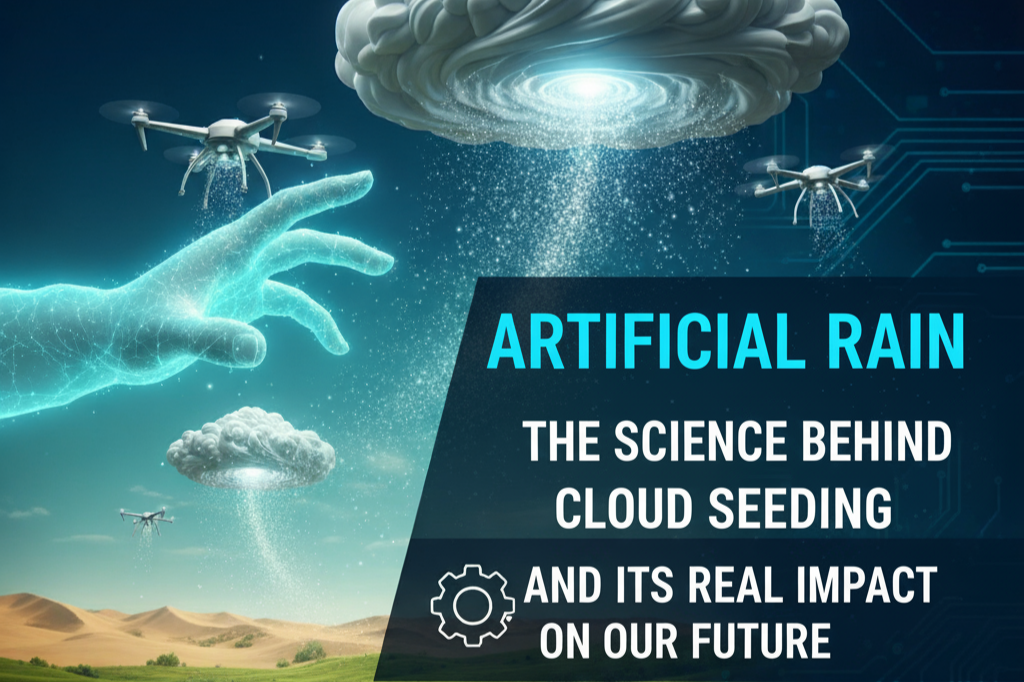
With advancements in Artificial Intelligence (AI) and drone technology, Cloud Seeding is becoming more precise and data-driven.
AI Algorithms analyze satellite imagery and weather data to predict the most effective time and location for seeding.
Autonomous Drones can deliver seeding materials with higher accuracy, reducing operational costs and human risk.
This integration of technology is expected to make Artificial Rain more efficient, eco-friendly, and scalable in the near future.
🌈 The Future of Artificial Rain
In the future, Artificial Rain could play a major role in sustainable weather management.
Scientists are exploring eco-safe materials and real-time monitoring systems to improve effectiveness while minimizing environmental risks.
If managed responsibly, Cloud Seeding could become a valuable tool for combating climate change impacts, improving agricultural resilience, and ensuring water security worldwide.
🧭 Conclusion
Artificial Rain represents one of the most fascinating achievements of modern science — a real example of how innovation can help balance nature, not replace it.
It offers hope for drought-prone regions and demonstrates how technology, when used responsibly, can create positive environmental change.
However, it must always be applied ethically, safely, and transparently, with constant scientific evaluation.
Artificial Rain is not about controlling nature — it’s about working with nature through science to create a more sustainable future.