🌿 Artificial Trees – The Future Machines That
Introduction: Can Technology Really Clean Our Air? Artificial Trees
Artificial trees are revolutionizing air purification
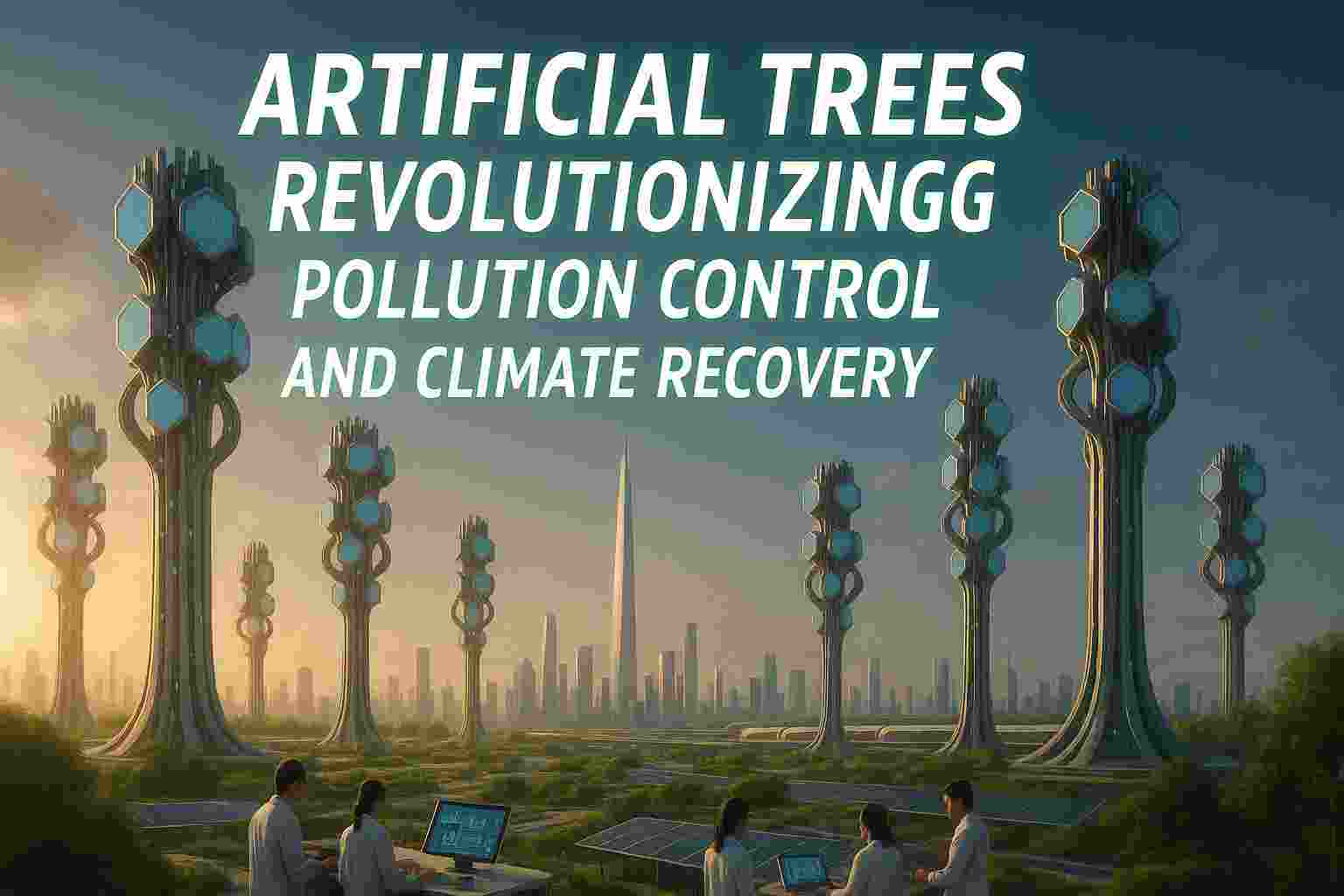
Imagine a city where instead of coughing from pollution, people breathe fresh air — thanks to artificial trees. These aren’t trees made of wood or leaves, but futuristic machines designed to clean the atmosphere like nature does. As climate change and urban pollution increase, these “pollution-eating” machines might soon become our planet’s best allies.
🌎 What Are Artificial Trees?
Artificial trees are advanced technological devices that mimic the natural process of photosynthesis. Instead of green leaves, they use special filters, chemical absorbers, and carbon-capturing technology to remove carbon dioxide (CO₂) and pollutants from the air.
These trees don’t grow like natural ones — they’re built, not planted. Each artificial tree can clean as much air as hundreds of natural trees combined, making them a revolutionary innovation in the fight against global
Artificial rain now detail this post
🧠 How Do Artificial Trees Work?
Artificial trees use a process called carbon capture and sequestration (CCS). Here’s how it works step-by-step:
- Air Intake: The tree’s surface or fan system pulls in surrounding air.
- CO₂ Absorption: The air passes through a special chemical solution or material (often sodium hydroxide or amine-based filters) that traps carbon dioxide.
- Clean Air Release: The purified air is released back into the environment.
- Storage or Reuse: Captured CO₂ is then compressed and stored underground or reused in industries (like making fuels, plastics, or carbonated drinks).
✅ Fun Fact: A single artificial tree can absorb up to 1 ton of CO₂ per day, depending on its size and technology.
💡 Why Do We Need Artificial Trees? artificial trees are revolutionizing air purification
Natural trees are the planet’s lungs, but they can’t keep up with modern pollution levels. Urbanization, deforestation, and industrial activities have drastically reduced forest cover. Artificial trees fill this gap by providing faster and more efficient air purification.
Key Benefits:
- 🌬️ Rapid Air Cleaning: Much faster than natural photosynthesis.
- 🏙️ Urban Friendly: Can be installed in cities, rooftops, or highways.
- ♻️ Recyclable Technology: Components can be reused and maintained easily.
- 🌱 Support for Nature: They don’t replace real trees but complement them.
🏗️ Real-Life Examples of Artificial Tree Projects
-
The CityTree (Germany)
Developed by a Berlin-based startup, Green City Solutions, the CityTree is a vertical panel covered with moss cultures. It absorbs pollutants and produces oxygen — equivalent to 275 real trees — in just one urban structure.
-
Carbon Engineering (Canada)
This company has developed large-scale carbon capture systems capable of removing 1 million tons of CO₂ annually. They are now testing smaller “tree-like” versions for cities.
-
Klaus Lackner’s Mechanical Tree (USA)
Professor Klaus Lackner from Arizona State University designed the Mechanical Tree — a structure that captures CO₂ from the air and stores it underground. Each tree can clean up to 1000 times more air than a natural one.
⚙️ Technology Behind Artificial Trees
| Component | Function |
|---|---|
| Air Intake System | Draws in surrounding air |
| CO₂ Filter or Sorbent | Chemically captures CO₂ molecules |
| Fan or Rotor | Maintains steady airflow |
| Solar/Electric Power Source | Powers the system |
| CO₂ Storage Chamber | Stores captured carbon safely |
These components make artificial trees both efficient and adaptable. Future versions may even run entirely on solar energy and integrate with smart city systems.
🔬 Future Possibilities & Innovations
In the coming decades, scientists envision entire “forest networks” of artificial trees working alongside natural ecosystems. These smart trees could communicate through IoT technology, report air quality data, and adjust their cleaning rate automatically.
Potential upcoming innovations include:
- AI-Controlled Air Monitoring Systems
- Nanotechnology Filters for more precise CO₂ trapping
- Self-Charging Solar Panels
- Compact Urban Installations for city corners, subways, and airports
🏙️ Artificial Trees vs. Natural Trees
| Feature | Natural Tree | Artificial Tree |
|---|---|---|
| Growth Time | Years or decades | Installed instantly |
| Carbon Capture | Slow | Rapid |
| Maintenance | Minimal | Requires periodic care |
| Cost | Low | Expensive initially |
| Eco-System Support | High | Moderate |
Both are essential — natural trees maintain biodiversity, while artificial trees tackle pollution in urban zones.
🌍 Global Impact: The Future of Clean Cities
If adopted widely, artificial trees could drastically reduce urban carbon footprints. Imagine a city where every building, park, and street corner has a few of these pollution-absorbing machines — turning cities like Delhi, Beijing, or Los Angeles into green zones of the future.
According to research from MIT and the University of Toronto, combining artificial trees with renewable energy could reduce global carbon emissions by up to 30% by 2050.
💰 Challenges and Limitations
Every innovation faces obstacles, and artificial trees are no exception.
Major Challenges:
- High Manufacturing Cost
- Energy Consumption
- Maintenance Requirements
- Limited Awareness and Government Support
However, ongoing research aims to make these machines cheaper and more energy-efficient. Countries like Japan, Germany, and the U.S. are already running pilot programs to integrate artificial trees with renewable power grids.
🌱 Conclusion: The Green Future Is Artificial + Natural 🌏💚
Artificial trees aren’t meant to replace nature — they’re designed to help it. As pollution and climate change rise, combining nature’s wisdom with human innovation could be the smartest way forward.
A world where both natural forests and technological forests work together isn’t just a dream — it’s the blueprint for a cleaner, greener, and sustainable future.
“`